
How to Stop an Epidemic: When SARS Came to the ER
Episode four
In 2003, SARS arrived in Canada. A Vancouver emergency physician received the first SARS patient at Vancouver General Hospital and the city managed to prevent an outbreak. At the same time in Toronto, SARS sparked a public health disaster. Hear how Dr. Filiatrault and her team in Vancouver put the precautionary principle into action, what public health can still learn from 2003, and what we need for good public health leadership. (Transcript below).
In March 2003, one SARS patient showed up in a Vancouver emergency room and another went to a Toronto emergency room. But two very different sequences of events unfolded.
Dr. Lyne Filiatrault was working in the Vancouver ER that day. Her team leapt into action and—with a little luck and a lot of preparation—prevented SARS from spreading at the hospital. A government agency immediately put in protections and built a firewall against SARS in BC, protecting staff, patients, and the public. Nobody died.
In Toronto, however, SARS exploited a system unprepared for the unknown. It would become the largest outbreak outside Asia. It shook the city and left healthcare workers and patients under-informed and under-protected. 44 people died. Many more contracted it as it was left to smoulder beneath shoddy protections and some overconfident decisions. (See Chapter 2)
In the aftermath, the SARS Commission report detailed the far-reaching failures in Toronto and how great work from healthcare workers and science advisors staved off a far worse outcome.
The report laid out instructions for how to avoid such a preventable public health tragedy in the future. It basically contained the cheat codes for how to stop a threat like COVID. But public health leaders largely seemed to ignore it, including Dr. Bonnie Henry, who was in Toronto when the SARS outbreak happened. Leading the COVID response in BC was not her first rodeo. In fact, she was the lead investigator in the Toronto SARS outbreak and testified in front of the Commission. (See Chapter 2)
Hear how Dr. Filiatrault and her team put the precautionary principle into practice against SARS in 2003, what public health can still learn from this story for the events of today, and what we need from good public health leaders heading into a future where more pandemics threaten us all.
*Correction: throughout this episode I refer to Scarborough Grace Hospital as Scarborough General Hospital, which is incorrect. Scarborough Grace Hospital is now called Birchmount Hospital and exists under the umbrella of the Scarborough Health Network, which also includes a Scarborough General Hospital.
As this episode mentions, a disproportionate number of healthcare workers who keep the system running in Canada are Filipino. The Filipino community in Vancouver is reeling from a violent attack at this year's Lapu Lapu festival. Much of the healthcare we have access to in Canada works because of the frontline labour of Filipino people, many who are women and immigrants. If you can, instead of chipping in to support this episode, please consider sending funds to the community-led Kapwa fund to support people affected by this awful event.
CREDITS
Public Health is Dead is created, hosted, produced, written and edited by Daniella Barreto.
Music, sound design and mixing by Alexandria Maillot.
Fact checking and production support from Anika S.
Editing support from Kevin Ball, Anika S. and Lauren M.
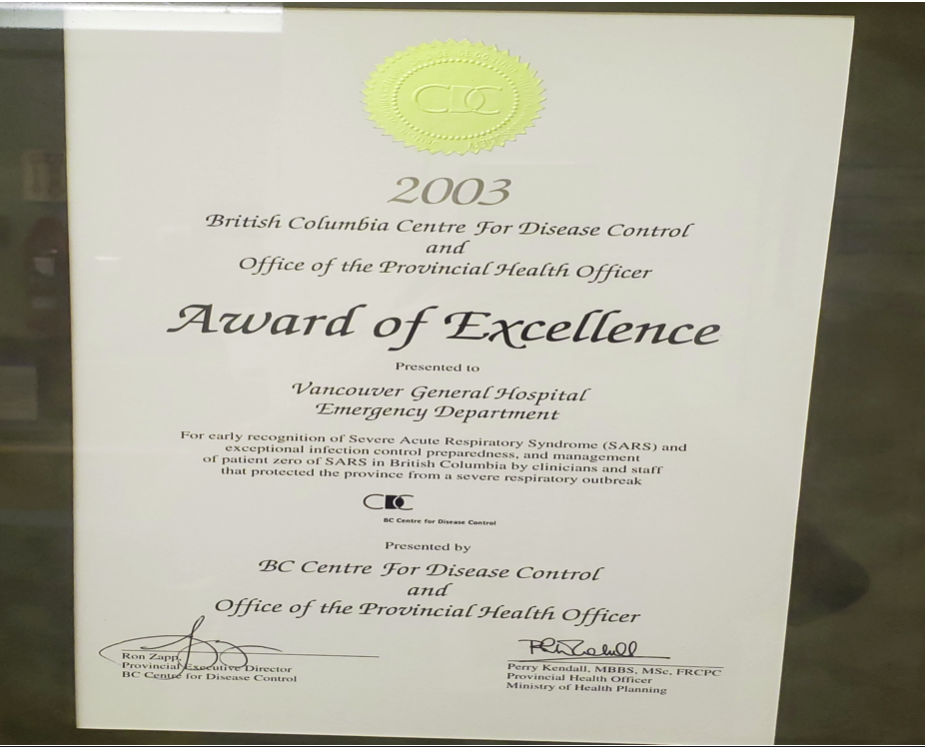
Image of Award of Excellence from the BCCDC (from Dr. Filiatrault)
CHAPTER 1: Vancouver - Dr. Filiatrault’s story
CHAPTER 2: Toronto - A city unprepared
CHAPTER 3: What makes a good public health response?
CHAPTER 4: Safety at Work
CHAPTER 5: What’s in a good public health leader?

Episode 4 artwork
Made by Daniella with public domain image components from the City of Vancouver Archives, Wikipedia, and CDC image of SARS-affected lung tissue.
-
Episode 4 -- How to Stop an Epidemic: When SARS Came to the ER
It’s 2003. Top of the charts – 50 Cent’s Get Rich or Die Tryin’ and Norah Jones’ Come Away With Me top the album charts. One of those is on my top-5 desert island records list, not saying which.
Finding Nemo came out. Myspace is launched. (What’s up Tom?),
iTunes is launched and Napster briefly reappears after getting into some legal hot water.
The scientific triumph of the Human Genome project is completed.It maps the entirety of human DNA, promising to unlock untold secrets for humanity’s future.
While sadly, Dolly the sheep, the first viably cloned animal, dies at the age of 7.
Do you know why she was called Dolly? She was called Dolly because she was cloned from breast cells and hee hee ha ha Dolly Parton’s boobs.Embarrassing. (Sheep baas)
Scientists are also products of the culture they grow in, I suppose.
The US unjustly invaded Iraq, the space shuttle Columbia exploded with astronauts on board, Zimbabwe’s economy continued to crash and my family immigrated to Canada. It was a year.
Besides 50 Cent, there was another thing on the charts in 2003 – SARS.
A precursor, some might even say a grave warning about COVID.
This episode: COVID’s cousin, SARS. What we can learn from how it was handled, what being prepared for a pandemic means, and what the qualities of a good public health leader are.
This is an especially timely episode as Canada searches for our next Chief Public Health Officer, replacing Dr. Theresa Tam. In addition to COVID, there will be more pandemics, that’s for sure. We just don’t know when.
Hi, I’m Daniella, and welcome to the show. This podcast is your anti-establishment field guide to surviving in the age of pandemics because public health leaders are failing us. And you deserve to know.You and your kids aren’t supposed to be sick all the time, and we should not have to be concerned about previously eliminated diseases (like measles) coming back. There’s a revolving door of preventable sickness and death all around us. But we can do something about it.
That’s what I hope this show can do: bring together the people who want to overhaul public health for a different future, and together figure out a path towards a public health that works for all of us.
If that’s you, welcome to Public Health is Dead. If you’re new to the show, it’s great to have you.
DANIELLA: In late 2002 to 2003, SARS-CoV-1, commonly known as SARS, or Severe Acute Respiratory Syndrome became an epidemic in China and then spread around the world from the now-infamous Metropole Hotel in Hong Kong.
Canada had the largest outbreak outside Asia. SARS landed in Canada in the Spring of 2003, sparking an epidemic in Toronto. 44 people died, and healthcare workers constituted the largest single group of SARS cases. The WHO would even go on to issue a travel warning for Toronto.In this tale of two cities I’m about to tell you, we’ll compare the Toronto response to that of Vancouver, who fared much better in the fight against SARS.
A note before we begin: This episode’s guest rarely gives interviews about her experience handling SARS because she says she just saw it as part of the job. She stresses that the story you’re about to hear was only possible because hospitals were not yet bursting at the seams with patients in 2003. The problem has snowballed rapidly since then. In 2011, one hospital had to use a Tim Hortons coffee shop as emergency patient overflow space! So, frustrated, on the 10th anniversary of SARS, our guest did an interview with the Vancouver Sun to warn of the public health threat that overcrowding and poor planning presents when we’re trying to containing disease outbreaks.
That’s what this episode is for. With public health leaders doing so little to stop airborne transmission of COVID, measles, bird flu, and more, it’s a word to the wise, a re-up of a cautionary tale, if you will.
On the crisp morning of March 7th, 2003, a physician walked in to start her shift in Vancouver General Hospital’s emergency department. What she didn’t know was that the fate of the city was about to be in her team’s hands…CHAPTER 1: Vancouver
DR. LYNE FILIATRAULT: it started as any regular day, so I got there early, went and picked up my coffee, and then had some time. So I looked at my emails and um, and when I did that, I saw that there was an email from the BCCDC…
DR. LYNE FILIATRAULT: My name is Dr. Lynn Filiatrault.
DANIELLA: Dr. Filiatrault moved from Montreal to BC in 1997 and spent most of her 20 years as an emergency doctor at Vancouver General Hospital or VGH
DANIELLA: (email ping) The email she sees that morning is from Dr. Danuta Skowronski, an epidemiologist at the BC Centre for Disease Control aka the BCCDC. They’d sent a few email alerts out starting in late February.
It warned:
DR. LYNE FILIATRAULT: there were some mysterious pneumonias happening in mainland China… be on the lookout for anybody coming back from, from Asia, particularly China, um, for possibility of an emerging, uh, bird flu or other emerging, um, respiratory illness. So I read the email, filed it in my brain bank, and went and did my shift.DANIELLA: It’s now 1:55 pm Vancouver time
DR. LYNE FILIATRAULT: There's an hour left in my shift and I'm standing at the nursing desk, my house staff, my medical student and my resident are seeing patients. So I'm waiting, uh, to review their cases, and all of a sudden I hear the triage nurse shout:
“ I need help, you know, help. I, I need help.” And, and I saw that she was wheeling a middle aged, uh, gentleman. … who was slumped over in the wheelchair and his, uh, I presume his spouse was following.And at the time it was myself and the respiratory technicians that were standing at the desk.
So we just, you know, lunge and went and helped. And there was a bed readily available.
DANIELLA: Like I mentioned at the top of the episode, in 2003, a quickly available bed was something that used to happen! If you’ve been into an emergency department in Canada lately, you’ll know waiting more than 10 hours is just normal now.
DANIELLA: Anyway, Dr. Filiatrault and her team hoist the patient into bed and do what usually happens in an emergency intervention - no questions asked, straight to the ABCs - airway, breathing, circulation. They undress the patient, put him on a monitor, supply oxygen and start an IV, do blood work, an ECG and a chest X-ray…
And it's only after that that once the patient is stabilized, that I turn my attention to the wife who starts giving me the story “ we just flew back from Hong Kong”.DR LYNE FILIATRAULT: She tells me “we both got sick, but I was, I got better. He didn't, and he deteriorated on the flight over,”
… already red flags are lighting up and so, um, at that point, uh, so we start masking, but I can tell you at that time I knew less about aerosol than I know now. And so we just, as we all do, so we all put surgical masks on.
The isolation room was occupied, so I didn't have that luxury. We're in a teaching hospital and normally when you refer. Uh, to a service. You often get a medical student or an intern who then reviews with a senior resident and so on. So I decided to bypass that and go straight to attending.
DANIELLA: Everyone has to communicate and work with each other in an environment like this. Dr. Filiatrault called over to radiology and said,
DR. LYNE FILIATRAULT: Hey, I've got this case. Can you have a look at his x-ray with the thought? Could this be an atypical viral pneumonia? And sure enough, the x-ray was compatible with a viral pneumonia. Doesn't tell you what virus. And he's looking better. But we're not out of the woods.
And as luck would have it, it was my mentor who was relieving me, uh, at the end of my shift, taking over.DANIELLA: Her mentor had just come back from Hong Kong in December
DR. LYNE FILIATRAULT: He was from there, had family, and he said, oh yeah, I read about this in the newspaper when I was there, about this atypical pneumonia spreading in mainland China
You know, emerge is very collegial. So charge nurse was Joanne and we all called her Mama Jo, leaves the nursing desk, and moves the patient that was in the isolation room and wheels, my patients in the bed in that isolation room.
DANIELLA: Isolation rooms are separate rooms where patients who are or could be contagious are treated to avoid passing any infections to other patients. Some isolation rooms also use negative air pressure, where the air pressure inside is lower than outside, so when the door opens, the air doesn’t rush out of the room and potentially take any pathogens with it.
DR. LYNE FILIATRAULT: the respiratory isolation cart is wheeled at the entry, so that means gown, gloves, um, and respirators. And um, and then basically from then on, it was respiratory isolation for anybody, uh, that was suspicious, that presented, um, with possibility. At the time we thought it was avian flu because you have to realize that the term SARS had not been coined. So we knew nothing about, uh, about SARS. Didn't exist.
DANIELLA: Dr. Filiatrault would call her parents in Montreal most days after her shift, update them about how she’s doing. She told them about her day that day
DR. LYNE FILIATRAULT: Hey, I saw this interesting case. You know, it could turn out to be an avian flu I described. And, and then I go on for a long weekend at my boyfriend, who's now my husband.
DANIELLA: Her time off was also when the news of SARS broke. Reports of this alarming new virus were sending shockwaves around the world and sounded very much like what Dr. Filiatrault had described to her parents… who seemed to have put two and two together.
DR. LYNE FILIATRAULT: And I come home and my answering machine, I didn't have a cell phone back then and my answering machine is blinking, blinking, blinking. The messages are full. Where are you? That's my dad and my mom saying, we're concerned. We just heard the news. Are you okay?
DANIELLA: Back at VGH after Dr. Filiatrault had finished her shift…
DR. LYNE FILIATRAULT: in the wee hours the patient arrest has a respiratory arrest and so it's a difficult intubation.
DANIELLA: An intubation is when doctors will send a tube down a patient’s windpipe to open the airway and administer oxygen, medication, or anesthesia.
Dr. Filiatrault’s team updated her when she went back to work–
DR. LYNE FILIATRAULT: my colleague that was on the side where the patient was isolated, uh, gets called to help with the intubation 'cause it's difficult. And then he calls another physician 'cause they're having a hard time intubating.
At the time the patient was in a negative pressure room.
DR. LYNE FILIATRAULT: the patient was intubated in that setting and, um, the respiratory technician and the resident, the internal medicine resident who found the patient in arrest, they didn't have time initially to put their mask, but they did, they didn't get infected. So there was a bit of luck.
DANIELLA: The emergency physicians then rush to the scene
DR. LYNE FILIATRAULT: And the emergency physicians had time to put on the protective gear. So, you know, gown, mask, uh, plus, I don't know if they use goggles, but at least an N95. And that's important because a lot of the infection in Toronto occurred during intubation. So there was a lot of staff, healthcare staff and nurses, physicians, respiratory technicians that were infected because they did not use, at the time, airborne protection. So they used surgical masks. They presumably weren't in a negative, at least initially, they weren't in a negative pressure room.
DANIELLA: As Dr Filiatrault says, there was a bit of luck involved because people were exposed, initially didn’t have the proper respiratory protection immediately at hand and were still not infected. But there was also a lot of preparation at VGH for instances like this. They were able to quickly move to effective respiratory protections. According to the SARS commission report, which you’ll hear much more about shortly, “Vancouver made its own luck” because the infection control and worker safety protocols at Vancouver General were based on a precautionary approach. (remember that word, it will come up a lot). If there was an undiagnosed respiratory illness, healthcare workers at VGH were trained to automatically go to the highest level of protection and then scale down if warranted as the situation was clarified.
This was unorthodox in 2003, one expert said of VGH at the time “we’re the heretics”, but that prudence and their approach paid off. There was no transmission to any healthcare worker who treated the patient with SARS or to any other patients at Vancouver General Hospital.
DANIELLA: Before we go any further, let’s introduce a very important player in the SARS response in Vancouver. I said VGH was prepared. That’s largely due to an agency called WorksafeBC, the agency responsible for, you guessed it, safety at work.
In the 6 months leading up to SARS, they had previously fit-tested workers with N95 respirators (these are masks designed to block airborne pathogens if they are worn properly and consistently. In a hospital setting it’s also a requirement that healthcare workers get tested for a make that fits their face correctly).WorksafeBC also had the authority to play a large role in making sure effective protective equipment was available and that training and guidelines were followed closely. They collaborated with a bunch of different players including unions, and WorksafeBC was probably the most important part of why SARS didn’t take off in Vancouver once it had been identified.
When WorksafeBC first heard about SARS in early March, they acted right away, insisting on the precautionary principle, which is basically better safe than sorry.DR. LYNE FILIATRAULT: There was some, uh, hard negotiation and it was thanks to occupational health and safety at WorkSafe BC saying, we're gonna go all out and we're not gonna take any chance. But you had some, uh, people in infection prevention and control that thought they were overreacting. So we were lucky that nobody, uh, downgraded airborne precautions to droplets because it would not have been, uh, so successful.
DANIELLA: If you want to know more about where the power struggle and confusion around airborne and droplet transmission started, listen to the previous episode called Something’s in the Air. There were definitely people, including in healthcare, who were anti-mask in 2003. The raging disputes we hear about masks and N95s in particular is far from a new sticking point. Similar backlash happened during SARS way before we heard it about COVID. Despite ongoing disagreements, all decisions at WorkSafeBC made were based on the precautionary principle - which was something most people could get behind. So even if it turned out that N95s weren’t necessary, these decisions communicated to workers that their employers cared about their health enough to take a threat seriously.
Just 3 weeks after learning about SARS, WorksafeBC issued a guide. They defined SARS-CoV-1 as a biohazardous material and under BC law, that designation required the employer (the hospital) to implement an exposure control plan.
This guide contained requirements for protecting workers from SARS, made sure hospitals knew their legal responsibilities as employers, and ensured workers knew when they could refuse unsafe work. For example, if they weren’t being provided with effective protective equipment.DANIELLA: There was another exposure at Royal Columbian Hospital in New Westminster, a nearby municipality, where a nurse contracted SARS from a patient. They still avoided an outbreak because of Worksafe BC’s insistence on ongoing inspections and worker protections. Occupational hygienists were there to supervise every shift change. They made sure healthcare workers were trained in safety procedures and correctly using their protective equipment.
DR. LYNE FILIATRAULT: WorkSafe BC got, got involved and forced infection prevention control to use airborne precaution. So suddenly, urgently, everybody working in emergency and on the floors where patients had been exposed were isolated. They didn't know if they were going to develop it. They used airborne precaution and had to really catch up fit testing everybody. There was a lack of N95. Because all countries were buying. So that should have been a warning sign for what was to come in, uh, 2019, 2020
DANIELLA: The WorksafeBC response at the time helped contain and prevent a major outbreak in BC by being prepared and bringing in a variety of experts in different fields to work collaboratively against a common threat.
While Vancouver was wiping its brow—Toronto was just beginning its fight.
CHAPTER 2: Toronto
One BC member on the SARS Science Committee said “I was shocked… I said well let’s just use the pandemic flu plan and everybody looked at me and there was no pandemic flu plan. And so . . I just got somebody to e-mail the B.C. pandemic flu plan over.”Yes, Ontario had to borrow BC’s pandemic flu plan because a plan for one disease was better than nothing. Ontario (the province Toronto is in) did not have one.
If you weren’t there, you can imagine it was more than a bit chaotic.
A patient arrived at the emergency department of Scarborough General Hospital on March 7th— the exact same day of Dr Filiatrault’s shift at Vancouver General— and a very different sequence of events unfolded.
They didn’t have the equivalent of the BC Centre for Disease Control. The ministry of Labour was sidelined and worker safety experts were not at the table to help make decisions. The hospital didn’t initially isolate the patient with SARS who was sitting in emergency for almost a whole day, breathing among other people the whole time. Ontario was not prepared in the same way to handle the unexpected.
DANIELLA: You hear the name Dr. Bonnie Henry a lot on this podcast, and for good reason. She’s been heavily involved in Canadian public health over the years and leading the COVID response was not her first rodeo. In fact, according to the Ontario SARS commission report, Dr. Henry was the investigative lead on the SARS outbreak in Toronto. At the time, there were two things happening, a measles outbreak and this new thing—maybe an influenza outbreak? She and a colleague decided Dr. Henry would lead the “probably-influenza” one because they thought it’d be over quickly. Dear listener, it would not. And it wasn’t influenza.Now, to be fair, it was a bit of a different situation compared to Dr. Filiatrault in Vancouver:
DR. LYNE FILIATRAULT: I saw the index patient. So the first patient. In Vancouver, the problem in Toronto was more complicated, and that's where we need to cut them a bit of slack, was that the visitor, the traveler that returned from the Metropole Hotel to Toronto went back to her family and she lived in the multi-generational family and she got sick, um, died at home.
There was no autopsy, but she infected her two sons, uh, daughter-in-law and I think a grandchild. So the patient that the, um, Scarborough Grace Hospital saw was not the index, they saw the son of that traveler and he had looked after his mom. Okay. And, um, and of course he waited, uh, in the waiting room and then was not isolated for about 21 hours.
DANIELLA: SARS initially had more of a chance to be passed between people in Toronto than it did in Vancouver.
DR. LYNE FILIATRAULT: And then when he got isolated, it was because the ICU staff thought, oh, maybe this is TB. And then it broke that it was SARS.
They certainly did not benefit from a communication system. They didn't benefit from, uh, surveillance of respiratory pathogens, uh, like we did at the BCCDC, um, and somebody reading their email and, and all of that, right.
There was a, there was a, a really a, it was kind of a reverse cheese model where we had less holes in our Swiss cheese than Toronto had.
DANIELLA: the Swiss cheese model is the idea that each layer of protection isn’t 100% protective. It has some gaps in its coverage. Thus, the holes in the Swiss cheese, but if there are multiple layers they reinforce each other to leave as few holes as possible
DR. LYNE FILIATRAULT: Toronto had a lot more holes. We did not have them. And yes, luck is part of it, but preparation and, and really. Better safe than sorry is, is what, um, helped us in Vancouver.DANIELLA: Hospital workers were getting sick. People were scared.
There was not enough personal protective equipment including N95 masks for healthcare workers. Some hospitals had never trained people how to use them before. Some didn’t even think training was required. It was a public health disaster, any way you sliced it.
(No cheese pun)Most of the information in this episode is taken from the SARS Commission final report, which was headed by Ontario Judge Archie Campbell.
Maybe I’m a huge nerd (probably) but it’s about 1200 pages long, it’s actually a really digestible and compelling read and I encourage you to download it and read it yourself for all the gritty details.
Here, I’ll give you the Coles Notes play by play but there is a lot more to the story I can’t get into but you should look it up because that could be an entire podcast series on its own.
Published in 2006, this report is essentially a playbook for what public health should do in a pandemic, laid out very clearly.
To me, it’s baffling that public health officials in Canada didn’t seem to turn it for COVID because this pandemic was an open book test with that report. It is an open book test.
And public health leaders are still failing.Astoundingly, some even had first hand experience with the failure and chose to make the same mistakes when COVID came around.
There were an incredible number of healthcare workers impacted by the SARS outbreak in Toronto.
In a hospital, occupational safety is supposed to protect workers and infection prevention and control is supposed to protect patients.
The two facets are meant to work together because it makes sense that protecting workers and protecting patients is intertwined but here, catastrophically failed.
In fact, 72% of everyone who contracted SARS in Toronto got it from a hospital. And almost half of them were healthcare workers. There were 3 main sites for the Toronto outbreak.
The first was Scarborough General Hospital, where the healthcare outbreak began in March, 2003. Other patients in the hospital contracted SARS from that incident. So did many healthcare workers.
The second site was St. John’s Rehabilitation Centre in May 2003.
And the third site was North York General Hospital also in May 2003.There are some dates coming up. I pulled them because the order things happened is fascinating but you don’t need to hang on to particulars.
From the end of March towards the end of April there were tough countermeasures in place to prevent SARS from spreading.There was a Code Orange across all hospitals to freeze hospital transfers and admissions – it halted the whole healthcare system.
And thanks to this, the outbreak was contained, it didn’t get into the community.
But on April 23rd, seemingly out of the blue, the WHO issued a travel advisory, the first one ever issued by the organization itself rather than by member countries.
The mayor, Mel Lastman, was angry, “angrier than he’d ever been in his life”, he said at a news conference. It was an economic shock for Toronto. Municipal and provincial leaders hopped on a plane to Geneva to try to convince health authorities to reverse it. Health Canada sent a formal protest, people were incensed.
The travel advisory was revoked a week after it was issued.About a week after that, on May 1 2003, Ontario and Health Canada triumphantly took out large newspaper ads saying “Canada has turned the corner on SARS” reassuring everyone that Toronto was safe for business and tourism and to come on back.
A couple of weeks later on May 17th the emergency was lifted, infection prevention and worker safety protections were relaxed; hospitals even held celebrations!
I’ll pause here to say if this sounds familiar to you and possibly ominous… you’re not alone.
The celebrations were short-lived. You saw this coming.
On May 23rd public health officials held a press conference to say (mic feedback sounds)
“ummm so there are a few new SARS cases at St. John’s Rehabilitation Centre.”
And, quietly,
“also a few at North York General Hospital are being investigated.”The media was like hold up, wait, what? I thought we were celebrating and the emergency was lifted??
And public health had to sheepishly admit that actually it was a major outbreak.
SARS was back.
But really, it never went away. If this is also sounding familiar to you… me too.Everything to avoid doing with COVID seems like it was written out pretty plainly in here.
As the report says - SARS was “left to simmer” in North York and then surged when protections were relaxed. It spread to patients, staff, visitors and their families.
Here’s a quote from the report: “We now know that behind the scenes a simple rule of nature was at work: Precautions go up, disease goes down; precautions go down, disease goes up”
One of the doctors who was involved even said this himself: “How did this bushfire start burning? It spread because the precautions came down.”
This was clearly a worker’s rights and health and safety issue. Nurses and healthcare workers had been told SARS was gone, contained, done, no new cases. The situation was over. But workers kept getting sick.
And get this— as hospitals were saying this, healthcare workers at North York General Hospital were seeing SARS-like illnesses with their own eyes in the psychiatric ward. They were told again by the hospital, nope, not SARS.
Well, turned out they were right – it was in fact SARS.
And they learned it the same day everyone else in the world did, at that press conference on May 23rd. SARS was not actually over.
In fact, there were new cases right under their noses, as they suspected. 39 workers got SARS at North York after they were told it was over. And again they had to keep working through it.
According to the SARS report, Dr Bonnie Henry was the public health physician most involved with the North York Hospital outbreak.
The press conference I just told you about on May 23, telling everyone that SARS was not actually over? The day before that, Dr. Bonnie Henry was in Taipei, explaining to Taiwan how Toronto had effectively controlled SARS through good communication.
That’s not the only place that was blessed with visitors from Toronto – she and some others involved in the response had taken off around the world in mid-to late-May to teach all about how Toronto conquered SARS and had figured the epidemic out. Bonnie Henry went to Hong Kong, Beijing and Taipei to share “the Toronto experience” of SARS and how they had successfully controlled it. Others went to Glasgow, New York, Washington to deliver high powered lectures while some went on vacation – Dr. Sheela Basrur, the Toronto Medical Officer of Health went to Jamaica for what the Globe and Mail called “a rest before West Nile season hits”.
Perhaps all a little hasty. One expert involved in the SARS response told the commission: “Nobody said well, how do you know it’s over? Including me... It’s just amazing that everyone blew it.”
Just a month earlier, On April 19th a man in his 90’s at North York for a pelvic fracture developed pneumonia. While some news reports suggest some doctors and nurses were wondering if it was SARS, because there was no clear link to anyone else with SARS, it was chalked up to being a hospital-acquired pneumonia and everyone went on their way.
This was a very different response to what Dr. Filiatrault’s team did in the Vancouver emergency room, erring on the side of caution. Unfortunately, the man died on May 1, 2003.Around the same time, There were 3 other psychiatric patients in the same hospital who mysteriously contracted SARS-like illnesses and because healthcare workers didn’t have that clear link as to where they may have contracted it, those patients were said to not have SARS. But they were treated in the SARS unit.
You see, the case definition for SARS at the time required a clear link, or epilink, to another SARS case or travel to a “SARS-afflicted” area, which led to the ridiculous situation where you could qualify for a SARS diagnosis if you’d travelled to China but not if you were literally a patient in a SARS unit.
So staff were told the patients didn’t have SARS, hospitals were reassuring worried staff that it was nothing to be concerned about meanwhile public health and other doctors were still monitoring those cases, called “people under investigation” right up until the public announcement at the end of May that there was actually an outbreak at the hospital.
Workers were in disbelief because they had been right. Many felt lied to.
To top it off there was confusing email communication from the hospital to the workers that the cases were probably SARS cases. Initially. But then they sent another email shortly afterwards saying “mm no actually they’re not probable SARS cases but classified as PUIs”.
This ended up being a bad move. Because there were whispers that maybe cases were being hidden to avoid another big international scene. After all, we saw what happened when the travel advisory was issued for Toronto.
The SARS commission decided the communication was a good faith mistake but conceded that unclear communications and a lack of a clear communications plan was a preparation problem at the root of the SARS outbreak.
After the outbreak became obvious, North York Hospital staff stepped up to contain SARS. Even if they felt angry or betrayed or disappointed or even afraid – they still did it. They shut down the hospital and contained what could have been a more deadly epidemic if it spread further.
Interestingly, there were no inspections from the Ministry of Labour until mid-June, after the outbreak had pretty much been contained. There were no inspections in March, April, or May even though healthcare workers continued to get sick.
Meanwhile In BC, if you remember, after that one Royal Columbian Hospital nurse contracted SARS - WorksafeBC did no fewer than 5 inspections at that hospital to make sure that all workers were protected.
North York Hospital did make a lot of changes afterwards to prevent another outbreak..
There was a new triage system at the emergency department, they increased the number of isolation rooms (you remember those), improved the ventilation, hired more infection control people and scaled up their education program, including, endearingly,, “instructions on CD ROM”.
If you’re new here, that’s a CD that you put in a computer and then it runs a program. Your laptop probably doesn’t have a slot for it. They used to!
But all of this clearly was not enough or maybe not even remembered when COVID or SARS 2 came knocking at Canadian hospitals and Long Term Care.DANIELLA: At the top of the episode I mentioned the Columbia Space shuttle explosion. The SARS report was written with the Columbia inquiry in mind - to assess the situation and place no blame. The SARS report says that it is hard to find blame because blame requires accountability. It says, “Accountability was so blurred during SARS that it is difficult even now to figure out exactly who was in charge of what”.
44 people in total died from SARS in Toronto. Across the country, 247 people contracted it.The SARS report says their lives should not have been lost in vain and we must never repeat this tragic public health failure.
There wasn’t much community spread with SARS, like I said, unlike COVID. That was likely thanks to swift public health actions within hospitals. The report notes an influenza pandemic would be much more catastrophic because of the scale of community impact and spread it would have. I think that bears repeating in light of the looming H5N1 influenza threat.
CHAPTER 3 - What’s in a good public health response?
DANIELLA: What should public health have learned from these two case studies – side by side – of the SARS response in Canada??Well, the SARS Report says if there is one thing to take away from reading it - and it really hammers this over your head - take this: the precautionary principle.
The precautionary principle is the idea that it’s better to be safe than sorry, especially when it comes to worker health and safety. So much of the confusion and danger to healthcare workers comes back to that wretched airborne/droplet binary that public health agencies just won’t let go of. If you want to know more about that, check out the previous episode called Something’s in the Air.
A short version is basically this, from the SARS report:“worker safety experts suggest that it is rare for a disease to be spread purely by droplet alone”. Meaning that baggy blue procedure masks are neither sufficient nor effective protection for an airborne workplace hazard exposure.It’s also dangerous to believe that any one person has all the answers. One doctor who was interviewed by the SARS commission actually said “Humility makes the better nurse and doctor”.
DR. LYNE FILIATRAULT:... this model of the hero leader, this leader who knows everything, and that's really what, uh, the government of British Columbia pushed is every time there was a, a critique about, uh, the pandemic management, uh, there was a political DARVO,
DANIELLA: DARVO is an acronym for Deny, Attack, Reverse Victim and Offender. It's a manipulation strategy often used to deflect blame and responsibility for wrongdoing.
DR. LYNE FILIATRAULT: that would take place by Adrian Disk saying, oh, we have, you know, world renowned expert, Dr. Bonnie Henry. Well. Uh, there was some legitimate gripe and nobody knows everything.
DANIELLA: Complex problems require many people’s expertise. One person can’t possibly know all the answers. Public health as a field needs to ask what has to happen for a better approach in public health disasters?
DR. LYNE FILIATRAULT: I think there needs to be a reckoning of, uh, public health and a reckoning of infection prevention and control. It is a bit mind boggling, um, that in BC uh, the public health officer…
DANIELLA: the PHO of BC is Dr. Bonnie Henry
DR. LYNE FILIATRAULT:… was in charge of the SARS response and was part of the SARS commission was called in to testify at the SARS commission and that these lessons weren't learned then, and they weren't learned again. In the ongoing COVID-19 pandemic.
DR. LYNE FILIATRAULT: one of the leaders I look up to more in Canada is Dr. Mona Nemer.
DANIELLA: Dr. Nemer is Canada’s Chief Science Advisor
DR. LYNE FILIATRAULT: Early on she brought a table of scientists to look at how is this virus spread? And they said, of course it's airborne. And she put out a report back in August of 2020 on how bio aerosol spread.DANIELLA: In September of 2020
DR. LYNE FILIATRAULT: And she was basically, you know, ignored by all the chief medical officer of health and the PHO of BC.
And lastly, the lesson from how SARS made its way around Toronto hospitals wasn’t to place blame but emphasize that systemic weaknesses could mean disasters like that at any other hospital in any community in any part of the country or any part of the world, being unprepared for public health disasters means a catastrophe.
Dr. David Patrick, who’s a BCCDC epidemiologist who was interviewed for the SARS commission (and who also much later taught me Control of Communicable Diseases in grad school) he said to them: ”It’s much easier to contain something that has never spread than it is to contain something once it’s off the ground”.
And Judge Campbell underscores: “if we do not learn from SARS and we do not make the government fix the problems that remain, we will pay a terrible price in the next pandemic.”
When COVID arrived, global public health leaders and institutions threw these warnings to the wind. And here we are – continuing to pay the price.Who had the answers to COVID?
DR. LYNE FILIATRAULT: it wasn't public health. It wasn't infection prevention and control. It wasn't government that was gonna have the answer is we needed all of society to come together. And we saw that. And that was part of the reason where I, I got involved with Protect our Province BC and now Canadian Aerosol Transmission Coalition is that the knowledge is not in public health. The knowledge is within engineering, the aerosol scientists.
DANIELLA: There was even an open letter to the WHO in 2020 signed by more than 200 scientists from more than 30 countries saying COVID is airborne. And guess what they highlighted? The precautionary principle.
Handling this new virus was a complex problem requiring more than just public health’s viewpoint.
DR. LYNE FILIATRAULT: the pandemic response in BC and in Canada was using a simple problem mindset. First it was the Great Barrington Declaration using herd immunity.
DANIELLA: The Great Barrington Declaration could be a whole episode to itself. It was an open letter published in 2020, signed by many controversial people including current NIH director, Jay Bhattacharya, pushing for everyone to go back to work and back to school except for the few most vulnerable to dying from COVID. The idea was to let it rip everywhere else to build up herd immunity in the population.
Now, herd immunity is a longstanding idea in population and public health that when most people are protected from a disease, often through vaccination, there aren’t enough susceptible people to sustain the disease so it dies down to a negligible level where most people don’t have to worry about getting it even they’re not vaccinated because they’re very unlikely to be exposed. Herd immunity makes it hard for a disease to pass through a population. With COVID that clearly hasn’t happened despite some people’s wishful thinking.
DR. LYNE FILIATRAULT: Our leaders didn't use that, but they used hybrid immunity, which is really a riff on herd immunity. You know, get vaccinated, get infected, and get boosted, and you're superhuman? No way. Never in public health have we ever used infection as a way of being protected.DANIELLA: Incredibly, Dr. Bonnie Henry did actually say this:
DR. BONNIE HENRY: “What we’re seeing is that people who have had a vaccine and infection, and then get their booster dose, are basically super-immune,”
DANIELLA: … not sure that’s working as wished. It’s like that xkcd comic — (get sick to get immunity to getting sick to get immunity from getting sick…) clearly not a great solution.DR. LYNE FILIATRAULT: the other thing that they, um, they used is vaccination as your, you know, as your silver bullet. And as one of my, um, co-author, Arijit Chakravarti he did, um, excellent presentation in November of 2020 saying, “Listen, there's not gonna be a silver bullet here. This virus evolves and by the time your vaccine is out, we're at a different variant and there's no lasting immunity to coronavirus and this one is not gonna be any different.” So everything that he said really panned out.
DANIELLA: We know that many people rushed to get vaccinated and were basically told they were free to rip off their masks and time travel to a 2019 that exists only in make-believe.And many did. Happily. Despite the world having fundamentally changed.
People are still dying. People are still getting sick. Some still don’t feel the same afterwards.
And there’s a fascinating depth to how long people can pretend there really is no problem with constant sickness everywhere.We still hear “well I’m vaccinated” as a response to concerns about COVID transmission and while it does prevent some of the more severe outcomes, many other things can happen after a COVID infection including strokes, heart attacks, and pneumonias. In fact, a study from April 2025 shows that people who have had a COVID infection are more likely to have other bacterial, viral and fungal infections for at least a year afterwards – yet again raising warning flags about what COVID could be doing to our immune systems.
You might have heard TB is on the rise in the United States, and, in my opinion, COVID may be playing a part in that. You might see an increase in TB if people’s immune systems were not working as they should because about a quarter of people actually have TB already, it’s just kept in check by the immune system. If something happens to the immune system, then TB can reemerge. That’s why it’s common to see TB and HIV, an immune-compromising disease, together.
Long COVID is sometimes treated as a surprise or an anomaly after a COVID infection, but post-viral chronic disease has existed for a long time.
COVID has only been here since 2019 so we can look to other situations to give us insight into what some of the possible longer term effects of viral infections could be
For one, recent research suggests Epstein-Barr Virus (EBV) can lead to multiple sclerosis. Researchers also suspect chronic diseases like ME or myalgic encephalomyelitis have a viral trigger. Many people who have Long COVID also meet diagnostic criteria for ME.
Besides paralysis and death in the acute stage, some of polio’s damaging long term health effects often only show up 15 or more years later.
HPV, human papillomavirus, can lead to cancer many years down the line (and in a huge success, HPV vaccination has cut cervical cancer significantly)
Some diseases like dementia and Parkinson’s disease have also been associated with an earlier viral infection.
AIDS, acquired immunodeficiency syndrome, often only shows up about 10 years after an untreated HIV infection.
Measles, which is currently exploding in parts of Canada, is a vaccine-preventable disease - one of public health’s successes and was an actual example of herd immunity. If someone does get measles and survives, they can get pneumonia, their immune systems can be damaged, and though rare, the long-term effects only show up 10 years later.
All this to say - long term health issues have often come along with previous exposure to pathogens like viruses. And sometimes only show up long after the initial infection.
What about SARS? If people didn’t die but “recovered” from their infection, as public health puts it, what happened to them?
DR LYNE FILIATRAULT: So 10 years on from SARS there were several articles that came out talking about long sars that people had not recovered. Not everybody, but there was certainly, um, uh, a group that really didn't, couldn't go back to work.
Um, were played with symptoms very similar. The shortness of breath, the fatigue, the brain fog, very similar to what we now know as long covid…
Some estimates suggest there are 400 million people living with some form of Long COVID. Some people might not even know. Actuaries, the people who run statistics to determine risk - often in insurance, have noted the ongoing damage of COVID to our health through excess mortality - so more people dying than expected - and in long term health risks. And healthcare workers are taking a huge hit, too. But their workplaces often treat COVID as no big deal.
Data on HCW and long COVID in Canada is not that easy to come by. One UK survey suggests a third of healthcare workers have long COVID symptoms, a BMJ Public Health article published in 2025 suggests it may even be 40% of healthcare workers struggling with issues like neurological symptoms, and fatigue. Some of these people are the people in charge of getting surgeries right, prescribing sensitive doses, making life or death decisions.Much of Canada’s healthcare labour force is also racialized and feminized - so people in jobs like nurse aides, orderlies and patient services associates, more than ⅓ are immigrants. Over 80% are women. And Compared to Canada’s population, disproportionately Black and Filipina. Work exposure to COVID is also clearly an equity issue.
As a reminder, we are just 5 years into COVID.How many times do we expect people, including young children, to get COVID and still be okay? Even if it’s once a year, that’s adding up to a lot over their lifetimes. We’ve already seen people who get COVID more often seem to have those long-lasting symptoms more often.
Our public health leaders seem very willing to bet our futures and our children’s futures instead of doing everything possible to mitigate what is preventable transmission. We’ve done it before. It’s not impossible to do it again.
CHAPTER 4: SAFETY AT WORK
If there is ONE thing to take away from this episode, it is - say it with me - the precautionary principle: we don’t need proof of causation beyond a reasonable doubt in order to take decisive action to protect workers. And by this point, airborne transmission is firmly understood to be a main route of COVID transmission and a route of transmission for many other diseases.
Droplet precautions for COVID and other diseases are insufficient protections.You might wonder what happened to that quiet and effective agency that built a firewall against SARS after Dr. Filiatrault received the first patient at VGH.
I have to wonder where the precautionary energy from WorksafeBC has been during the ongoing COVID crisis? Why does WorksafeBC seem so quiet? Or were they quieted?
The truth is, I don’t know. I went down a few rabbit holes but I’d love to hear from anyone who does.
WorksafeBC were the first in Canada when COVID kicked off to establish that for any healthcare worker who got COVID, it would be presumed that it was from work.
That vanished when Dr. Bonnie Henry declared the provincial emergency to be over in July 2024.
But from my read that didn’t change the occupational health and safety regulations.
Please briefly join me down the rabbit hole:
Those regulations say that you need an exposure control plan based on the precautionary principle if workers could reasonably expect exposure to a biological agent designated as a hazardous substance in the workplace.The Worksafe definition of biological agent that is also a hazardous substance is anything categorized by PHAC to be a Risk level 2,3, or 4, human pathogen that causes an adverse health effect.
So I searched the PHAC website.They have a risk group database called e-Pathogen. I looked for SARS-CoV-2…in there SARS-CoV-2 is in fact categorized as a Risk Group 3 human pathogen along with HIV and TB.
Since it’s a risk group 3 biological agent designated as a hazardous substance… shouldn’t there be effective exposure control plans in hospitals?It’s pretty clear that people who are sick with SARS-CoV-2 go to hospitals and healthcare workers whose job it is to care for them are then exposed to SARS-CoV-2 that biological agent designated as a hazardous substance in the workplace. It sounds like healthcare workers’ employers are supposed to develop and implement an exposure control plan based on the precautionary principle to eliminate or minimize potential for exposure to that biohazardous substance.
Is this why public health leaders are so reluctant to admit COVID and other diseases are airborne?
CHAPTER 5: What’s in a good public health leader
DANIELLA: In Vancouver the SARS crisis was averted. Thanks to strong leadership and a commitment to being prepared. After much struggle, tragedy, and relentless invaluable work, especially in containment from the Ontario Science Advisory Committee, Toronto came out the other side as well, pledging to update its systems and preparation.In fact, the PHAC - the Public Health Agency of Canada was created in the wake of the SARS epidemic as a way to better manage public health on a federal level. And the current leader’s term is up soon.
Now that we know what makes a good public health response, it’s got many of us wondering what makes a good public health leader at that level…
Luckily, Dr Filiatrault (who is not in the running) and the co-author she mentioned, Arijit Chakravarty, along with Dr. David Fisman, an epidemiologist at the University of Toronto, wrote an article about just that. I’ll link it in the show notes. It’s called “What makes a good public health leader”.
They said: “We need someone who, with humility, learns from past mistakes, applies the precautionary principle, engages with evolving science, and earns public trust by speaking hard truths. As soothing as "Be Kind, Be Calm, Be Safe" may sound, without action, it’s just another empty slogan. Canadians (and here I'll add: everyone!) need someone who takes timely, decisive actions to truly protect us. Now, and when the next pandemic strikes”
DR LYNE FILIATRAULT: months later I get this phone call, somebody saying, Hey, we have an award, uh, that we want to give you at this ceremony at the BCCDC. And I was a bit surprised about it. To me, it was, I was doing my job, I said, "there's no way I'm gonna, I'm gonna do this". And I said, "listen, first of all, make it to the emergency department because this was a team effort."DANIELLA: She didn’t go to the ceremony and went to do her shift at the emergency department instead. But if you go to the Vancouver General Hospital emergency room (hopefully without something else that needs attention) it's posted on the wall just in front of registration in the emergency department.
DR LYNE FILIATRAULT: That's where the award is. But to me, it was really all about a team coming together and doing, you know, what we're there to do is treat the patient, protect your staff, protect your community. It's not about one person.
DANIELLA: The public health leaders we have, locally and globally could do so much more to stop airborne infections from being passed around. They could educate us all about airborne disease transmission, mandate large scale building upgrades, and communicate them when they happen… the only plan right now seems to be ‘forever sickness’.
DR. LYNE FILIATRAULT: Right now we need clean air. if parents don't want their kids to be sick all the time and they don't want them to get long COVID, whatever else, you know, new autoimmune disease, diabetes, you name it, we need clean air.
If we can choose new public health leaders who are:
courageous enough to learn from the past,
visionary enough to see a different future is possible,
principled enough to put human lives above profit,
strategic enough to build alliances with people from different fields, and emphasize the importance of teamwork…
Maybe then we’d have a shot at fixing the immediate mess of COVID and be able to really prepare for what’s coming at us next.
CREDITS
Public Health is Dead is created, produced, written, hosted, and edited by me, Daniella Barreto
Music, mixing, and sound design by Alexandria Maillot
Production support and fact checking by Anika S.
Content editing support from Kevin Ball, Anika S, and Lauren M.
Public Health is Dead is an indie production, which means this show is lovingly made for you , entirely out of pocket by me and a few wonderful folks who pitch in their time. This episode took more than 50 hours when I wasn’t working my day job so there’s no etched in stone schedule but we hope to have one out approximately every other month and will keep trying different things. If you like what you hear, please share this episode and consider helping out to keep production going. You can support the show at publichealthisdead.com. A giant thank you to everyone who has supported the show already!
While this podcast focuses mostly on COVID, its impacts, and infectious disease, like I say in the very first episode – public health is a lot of things….
If you like this show, you might like Everything is Public Health! It’s a podcast about how everything is public health, and public health is for everyone. Do we have clean air to breathe? Is our tap water clean? Does our neighborhood encourage walking or is it built for cars? Are our buildings up to code? Public health is everywhere, but it doesn’t get the love it deserves because public health works to prevent bad things from happening. It probably saved your life multiple times, and you didn’t even know it. This podcast hopes to highlight how everything is public health, even the silent things in the background. New episodes every week, find it wherever you get your podcasts.